From Kitchens to Pools
 Platapode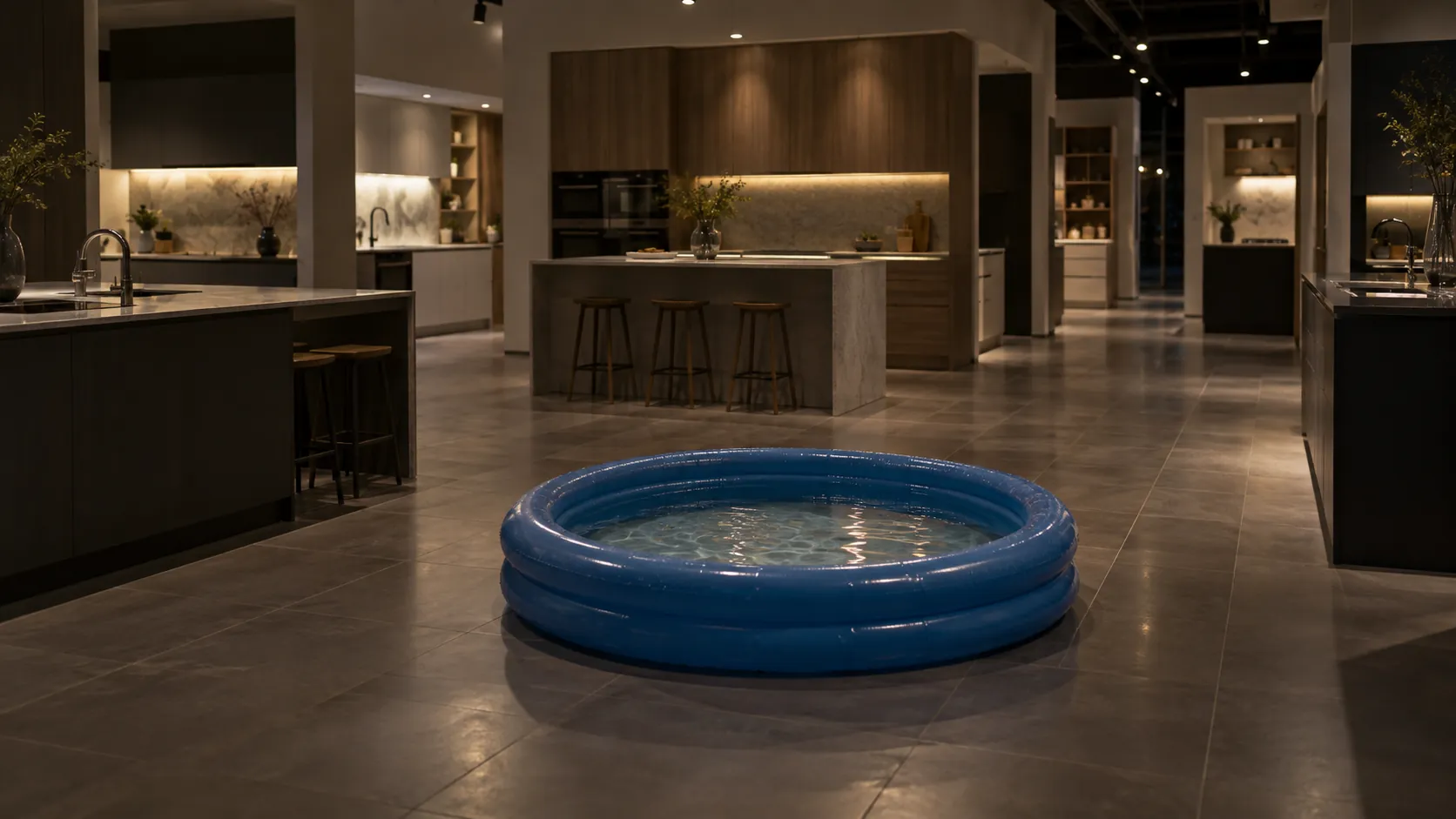
A thought experiment. The client is made up. The question is real.
The email came in at 9.52 on a Thursday night. The subject line was "honest question." It began, as they all do, with "not havin' a go."
The owner of a kitchen renovation business had spent the evening at his own kitchen bench, which is laminate and from 1994, typing into an AI. He'd asked it to build him a Google Ads campaign, and it did, in about 1 minute. Keywords, headlines, a budget spread across the week, locations set around his showroom.
His email was three lines long.
"Not havin' a go. Why am I paying you when AI can do this?
(It did them in Spanish too.)"
It was a fair question. He'd watched it happen.
There's a standard reply to that email, and it goes something like: AI can't do what we do. It's the wrong reply. Not because it's rude, but because it's the kind of claim you should be able to prove.
So we ran a test. Two campaigns in the same account, the budget split down the middle, the same landing page and the same offer: a measure and quote. Each side had its own settings, so a change on one didn't touch the other. Sixty days. AI made his campaign, then disappeared. We didn't touch it for 60 days. Ours was ours, and we touched ours.
The first thing we learned was that the AI isn't bad at the work. It's very good at the work. It just has no way of knowing whether the work is any use.
It's a megaphone. Whisper "good" into it and it comes out enormous: sixty headlines, a thousand keywords, a finished campaign before you've found your keys. Whisper something slightly wrong and that comes out enormous too, at the same speed and with the same confidence.
| Round | AI | Human | |
|---|---|---|---|
| 1 | The build | 1 min | A little longer |
| 2 | The words | 60 | A little less |
| 3 | The junk | Anyone with a device | – |
| 4 | The win | 400 conversions | 38 bookings |
| 5 | The plan | Ran it | Saw it |
| 6 | The boring jobs | Did them | Handed them over |
Round one · the build
The AI had the whole campaign standing in about a minute. It sorted the ad groups (the folders the ads live in) by job type, put keywords under each one, and set a 40-kilometre ring around the showroom.
Ours took a little longer, and that little bit longer went into decisions the AI hadn't made and hadn't been asked to make. AI, round one.
Round two · the words
The AI wrote sixty headlines in about 15 seconds, every one under thirty characters, which is the limit. We wrote 15. Not because we needed 15 or had 15 worth saying, but because that's the limit, and we didn't want to look lazy. We would have been happy with fewer than six. Our best were pinned.
Round three · the junk
With that many ads live, the account started showing up for a lot of searches: the actual words people typed before they clicked. There were 940 different ones in the first fortnight.
The searches came in faster than we could scroll: "kitchen renovation apprenticeship", "ikea kitchen hack", "my kitchen rules full episodes" and "outdoor kitchen next to pool". It kept every one.
Round four · the win
Every account has to be told what counts as a win, meaning the thing it should get more of. In the AI's campaign, a win was anyone who filled in the quote form. It also counted anyone who opened a gaming app where one of its ads had shown up, even if they didn't see it: somewhere tiny, invisible, on sites the business would have picked last.
AI was superior. Far superior. At reporting inflated numbers.
We sat modestly watching our lead forms come through.
Then we sat down with the woman who chases the leads. Most hadn't left a number. One, sent at 11.40pm, said: "renting, just curious, would landlord pay?" Another wanted a quote for a cubby house.
The AI had done a perfect job of finding anyone. Anyone who doesn't own a kitchen. Nobody had asked it to do that.
Round five · the plan
What we had that the AI didn't was a way to see where each booking came from. That's not intelligence. It's plumbing.
The brief said the best customers were full renovations in the older, leafier suburbs to the east, and both campaigns were built around that. Somewhere in between weeks 1–3, the enquiries started changing: "replace leaking tap", "plumbing for strata building".
Round six · the boring jobs
We handed some of the boring jobs outside the account to the AI. Reports, notes, first drafts, the knick-knacks. It did all of it, daily, without being reminded. It even offered to do more. AI, round six.
At the end of the sixty days, the AI's campaign sent its report.
It was magnificent. Numbers falling from heaven, green arrows, the kind of document you want to print and put on a wall.
We sent the owner one email of our own. "Not havin' a go," then the usual.
| AI | Us |
|---|---|
| 400 conversions | 38 bookings |
The AI was fast, and it's certainly not weak.
The owner read our email and, as anyone would, fed it straight back into the AI and asked what to do next.
The AI came back with a brand new strategy. A hundred and twenty headlines. Seventy ads. And it had generously expanded the services on offer. No longer just kitchen renovation.
Pool installation.
He forwarded it to us.
"Not havin' a go. But why am I advertising pool installation?"
This isn't really about Google Ads. It applies anywhere you can now make a lot of something fast: emails, reports, code, job ads. The AI made the doing cheap, and that made the deciding expensive. You still need a person. Not because the AI can't do the work, but because it can't tell you whether the work should be done.
Tell it what good means.